

AI Coaching Roleplay for Corporate Training: How It Works and Why Teams Use It
Traditional roleplay training doesn’t scale. Here’s how AI coaching roleplay is helping corporate training teams deliver realistic, measurable practice at scale.
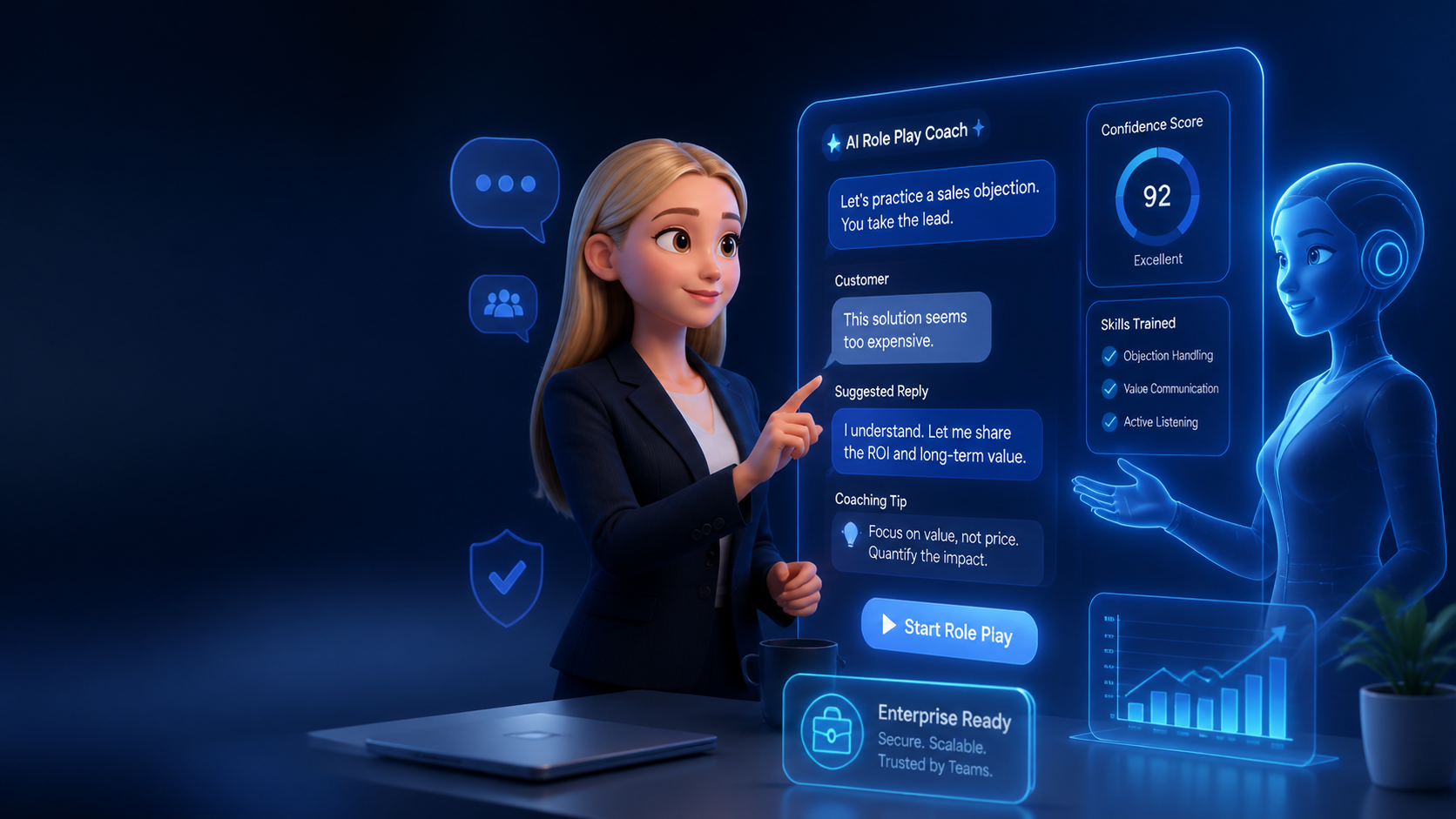
Corporate training teams have always known that people don’t build real skills by reading a slide deck — they build them by practicing. That’s why roleplay has been a training staple for decades. But AI coaching roleplay for corporate training is changing what that practice looks like: instead of scheduling a manager or peer to play a difficult customer or an underperforming employee, teams can now run realistic, on-demand simulations with an AI that responds like a real person and gives structured feedback afterward.
If you’re evaluating whether this approach fits your training program, here’s what it actually involves, how it compares to traditional roleplay, and where it delivers the most value.
What Is AI Coaching Roleplay?
AI coaching roleplay uses conversational AI to simulate realistic workplace scenarios — a sales objection, a difficult performance conversation, an angry customer — so employees can practice their response in a safe, repeatable environment. After the conversation, the AI evaluates the interaction against specific criteria (tone, structure, objection handling, empathy) and gives feedback the person can act on immediately.
It’s the same principle behind traditional roleplay training, just without the scheduling bottleneck of needing another human in the room every time someone wants to practice. If you want a broader introduction to the category, see our guide on what AI roleplay is.
Why Traditional Roleplay Training Falls Short at Scale
Roleplay works. The problem has never been the method — it’s the delivery:
- It doesn’t scale. A manager can only roleplay with one person at a time, which makes consistent practice across a 50- or 500-person team logistically difficult.
- Feedback is inconsistent. Two managers running the same roleplay scenario will coach it differently, so employees get uneven guidance depending on who’s in the room.
- It’s hard to repeat. Real skill-building requires reps, but few teams can justify pulling a manager into a room for the fifth or sixth practice run with the same employee.
- It’s uncomfortable. Practicing a hard conversation in front of a manager or peer changes how people perform — many hold back exactly the behaviors you’re trying to train.
This is where AI-based practice changes the equation: employees can run the same scenario as many times as they need, get the same evaluation criteria every time, and practice without an audience.
How AI Coaching Roleplay Works for Corporate Training
A typical AI coaching roleplay session follows a simple structure:
- Scenario setup — the trainer or L&D team defines the situation (a sales discovery call, a feedback conversation, a customer complaint) and the behaviors being assessed.
- Live simulation — the employee has a real, back-and-forth conversation with the AI, which adapts its responses based on what the person says.
- Structured feedback — after the conversation, the AI scores the interaction against the defined criteria and highlights specific moments to improve.
- Repeat practice — the employee can rerun the same or a harder version of the scenario until the behavior sticks.
Because every session is logged, L&D and management also get visibility into practice volume and skill trends across the whole team — something that’s nearly impossible to track with manager-led roleplay.
Where Corporate Teams Use It
AI coaching roleplay tends to deliver the most value in a handful of recurring training moments:
- Sales onboarding. New reps practice discovery calls and objection handling before they’re in front of real prospects, which directly affects how fast they ramp. If you’re benchmarking this, our post on how long it takes a new salesperson to reach full productivity breaks down typical ramp timelines.
- Leadership and management training. Managers practice difficult feedback conversations, performance reviews, and conflict resolution in a low-stakes environment before having them for real.
- Customer service training. Reps rehearse de-escalation and complaint handling against realistic, adaptive customer personas rather than a static script.
- Ongoing skills reinforcement. Instead of a one-time workshop, teams use short, repeatable simulations to keep skills sharp long after the initial training session ends.
What to Look for When Evaluating an AI Roleplay Tool
If you’re comparing options for your training program, a few things matter more than others:
- Realistic, adaptive conversation — not a decision-tree chatbot with pre-scripted branches.
- Configurable scenarios — the ability to build scenarios specific to your product, policies, and team, not just generic templates.
- Objective, criteria-based feedback — scoring tied to specific behaviors, not a vague “good job” or “needs work.”
- Manager visibility — dashboards or reports that show practice volume and progress across a team, not just individual session results.
- Integration into existing training — the tool should fit into onboarding and ongoing L&D programs, not sit as a separate, disconnected exercise.
Is AI Coaching Roleplay Right for Your Training Program?
If your team already runs roleplay-based training but struggles to make it consistent, scalable, or measurable, AI coaching roleplay solves the delivery problem without changing the training method your team already trusts. It’s particularly effective for onboarding-heavy teams, distributed teams that can’t easily schedule in-person practice, and any program where manager time is the bottleneck to more practice reps.
Want to see how it works with a scenario built around your own team’s real conversations? Book a demo to try it with your own use case.
FAQS
Because a manager can only run one roleplay session at a time, teams face a scheduling bottleneck, get inconsistent coaching depending on who’s running the session, and rarely get enough repeated practice to make a skill stick — the same limitations we cover in the “Why Traditional Roleplay Training Falls Short at Scale” section above.
It follows four steps: the trainer sets up the scenario and the behaviors being assessed, the employee has a live back-and-forth conversation with the AI, the AI scores the interaction against those defined criteria, and the employee can repeat the same or a harder version of the scenario as many times as needed.
Based on how teams are using it today, the four biggest use cases are sales onboarding and objection handling, leadership conversations like feedback and conflict resolution, customer service de-escalation, and ongoing skills reinforcement after the initial training is over.
Beyond realistic conversation, look for configurable scenarios built around your own product and policies, objective criteria-based feedback (not vague scoring), manager-level visibility into practice volume across the team, and easy integration into the onboarding and L&D programs you already run.
Yes — practicing discovery calls and objection handling before facing real prospects is one of the clearest levers for ramp time. If you want the specific benchmarks, see our related post on how long it typically takes a new salesperson to reach full productivity.
No — it solves the delivery problem (scheduling, consistency, repeatability) without changing the training method your team already trusts. It’s most useful for onboarding-heavy or distributed teams where manager time is the real bottleneck to more practice.