

When sales coaching stops scaling: how to get out of the endless 1:1 with every rep
Sales coaching that protects your time: how to stop being your team’s bottleneck and get every rep to improve without depending on you for every conversation.
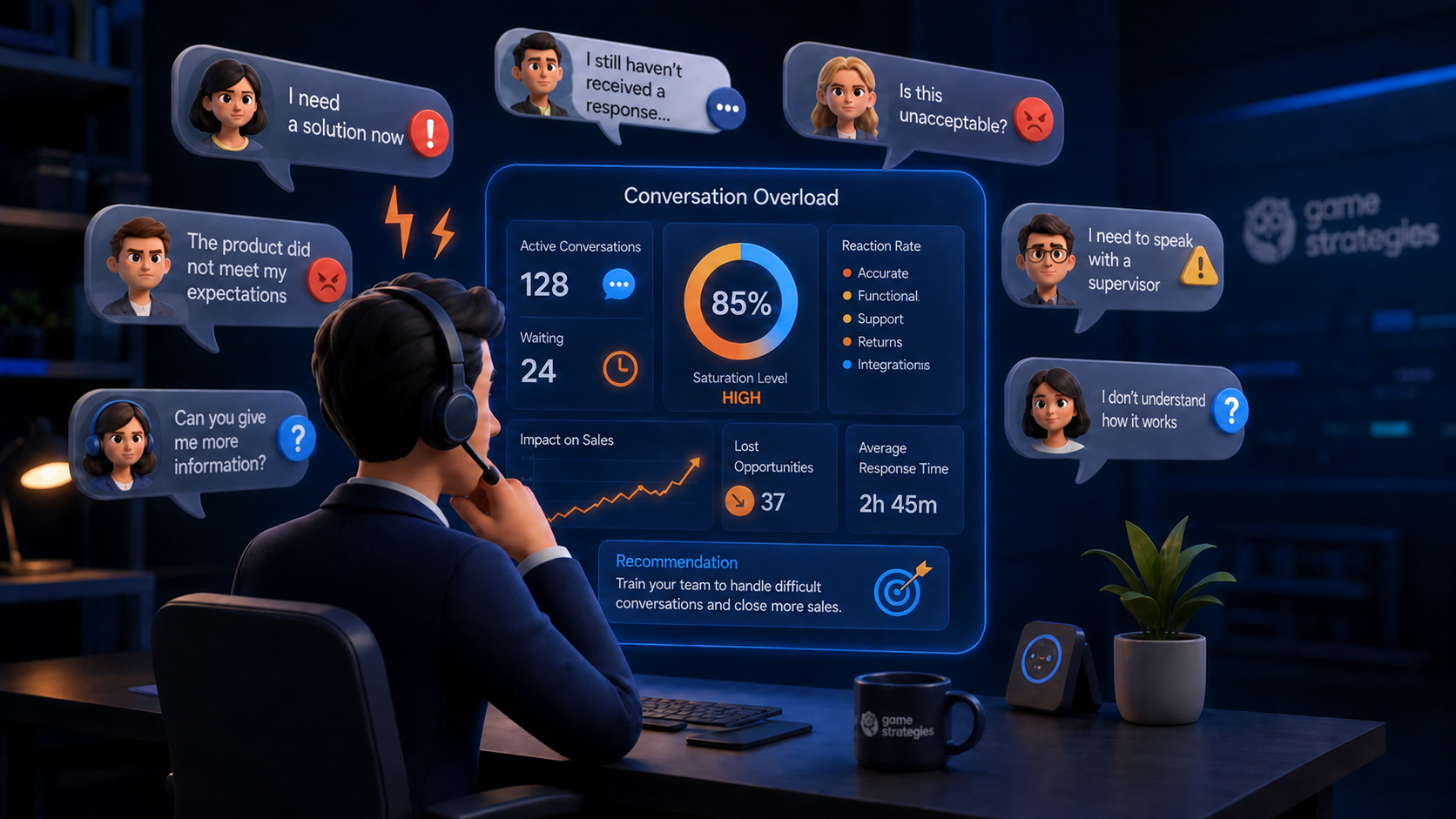
There’s a point where almost every sales leader reaches the same conclusion: they’re spending more hours doing individual coaching than actually running the business.
Three reps. Four reps. Six reps. A calendar blocked Monday through Friday with 1:1s where you review pipeline, break down the last call that went sideways, and prep for the next big meeting. It works, by the way, right up until the seventh person joins the team and the whole system collapses.
That’s sales coaching that doesn’t scale, in action.
It’s not a failure on your part. It’s a design failure in the model.
Why 1:1 Coaching Is Necessary But Not Sufficient
The individual 1:1 has real value. It’s where you catch a specific rep’s blockers, where you can go deep, and where the relationship gets built. No article should tell you to cut it out.
The problem starts when the 1:1 becomes the team’s only development mechanism.
When that happens, here’s what follows:
- The manager becomes the bottleneck. If you don’t have time for the 1:1, the rep stops improving. Development depends on your availability, not the rep’s need.
- Feedback is slow. Days can pass between the call that went badly and the session where you actually break it down. Learning loses its power when it isn’t immediate.
- Scale is linear, not exponential. Hire one more rep, you need one more hour of weekly coaching. Hire three more, you need three more hours. The model doesn’t grow with the team.
- Knowledge doesn’t transfer. What you learn coaching Rep A doesn’t automatically reach Rep B. Every 1:1 starts from zero.
In most fast-growing sales teams, the 1:1 quietly shifts from a development tool into a pipeline review meeting with a bit of coaching tacked onto the end, whenever there’s time left.
The Signs Your Coaching Model Has Stopped Scaling
Before looking for solutions, it’s worth identifying where the real problem sits. These are the most common signals:
Time signals:
- You spend more than 30% of your week on individual coaching sessions or call prep with reps
- You cancel development 1:1s whenever there’s deal pressure or travel
- Some reps have gone more than two weeks without structured feedback
Quality signals:
- Every rep makes the same basic mistakes in discovery or demos, even the ones who’ve been on the team a while
- Feedback given in 1:1s gets forgotten within 48 hours because there’s no follow-up practice
- You have no visibility into how many times a rep has practiced a conversation before running it with a real client
Scalability signals:
- Every time a new rep joins, your calendar reshuffles for months
- Senior reps are starting to informally coach junior ones because you don’t have the capacity
- When someone on the team has an important meeting, they call you to prep instead of using a system of their own
If you recognize three or more of these signals, the problem isn’t the content of your coaching. It’s the structure.
The Shift Few Teams Make: From Reactive Coaching to a Practice System
There’s an important difference between coaching and practice.
Coaching is the conversation where a manager gives feedback, identifies the gap, and proposes improvements. It’s necessary and valuable. But coaching without practice is like explaining to someone how to swim without ever putting them in the water.
What breaks down in most teams is the practice part: the space where a rep can execute what they’ve learned, get it wrong, correct it, and repeat, before a real client is on the other end of the conversation.
The model that actually scales combines two layers:
Layer 1: group coaching on common patterns. Instead of individually reviewing the same mistakes with every rep, identify the three or four failures costing you the most deals and work through them as a group. One 45-minute weekly session reviewing a single type of conversation with the whole team has more cumulative impact than six 1:1s repeating the same feedback.
Layer 2: independent practice outside the 1:1. This is the piece most teams are missing entirely. Reps should be able to rehearse a discovery call, a demo, or a tough renewal without needing the manager available. Without burning a real client. With feedback that arrives in the moment, not two days later.
Once this second layer exists, the 1:1 changes in nature. It stops being the place where the rep practices for the first time and becomes the place where you go deeper on what they’ve already rehearsed. That’s what finally makes it efficient, and scalable.
How to Build a Coaching System That Doesn’t Depend on You
These are the structural changes that separate an endless 1:1 model from one that scales:
1. Define which conversations deserve practice before the 1:1
Not every conversation needs the same level of preparation. Start by mapping the three or four moments in your sales process where mistakes cost the most: opening a discovery call, presenting price, a renewal with an unhappy client.
Those are the scenarios that deserve structured practice before they reach the client meeting, and before they reach your 1:1.
2. Separate pipeline review from skills development
One of the most common mistakes is mixing both into the same meeting. Pipeline review is about deals. Development is about skills. When you combine them, pipeline always wins because it feels more urgent, and coaching gets squeezed into the last five minutes.
Put two clearly separate meeting types on your calendar: one for reviewing the business, one for developing the rep. And protect the second one.
3. Design practice scenarios reps can use without you
This is where most teams have a gap. Can a rep on your team practice a discovery call today with a buyer profile that resembles their target accounts, get immediate feedback on what worked and what didn’t, and repeat it as many times as they need?
If the answer is no, your coaching system depends entirely on your availability. If the answer is yes, you have an independent practice layer that multiplies the impact of your 1:1s.
AI-powered conversation simulations enable exactly this: configure realistic scenarios by conversation type, buyer profile, and situation, and let every rep practice on their own time, at their own pace, with structured feedback. Not as a replacement for the 1:1, but as the practice layer that makes it more efficient.
With tools like AI Role Play you can build these scenarios in minutes: choose whether it’s a discovery call, a demo, or a renewal conversation, define how the buyer behaves, and roll the simulation out to the whole team. By the time the 1:1 comes around, the rep has already practiced that scenario several times, and the conversation goes straight to what actually needs work.
4. Build a “library” of your team’s critical scenarios
Over time, the best sales teams accumulate knowledge about which conversations are hardest, which buyer profiles cost the most, and which objections keep coming up. That knowledge usually lives in the manager’s head, and when the manager leaves or changes roles, it disappears with them.
A scalable practice system turns that knowledge into reusable scenarios: concrete situations any rep can practice, that reflect the reality of your deals, and that get updated as the market shifts.
The “Good Coach” Trap That Holds Teams Back
There’s a paradox worth naming: the best individual coaches are usually the slowest to let go of the 1:1 model.
It makes sense. If you’re good at giving feedback, your reps improve because of your sessions, and that reinforces the system. The problem is your time is finite and your team isn’t.
Being a good coach doesn’t mean being your team’s only development resource. It means designing a system where the team can improve even when you’re not available.
That shift in mindset, from “I do the coaching” to “I design the team’s improvement system,” is what separates a great manager from one who scales.
What You Can Change This Week
If you want to start moving out of the endless 1:1 without redesigning your entire coaching structure, start with three concrete moves:
Identify the two or three conversations where most reps make the same mistakes. Those need structured practice, not more explaining.
In your next 1:1, set aside the first 10 minutes purely for feedback on a real or simulated conversation the rep has already had. Not for pipeline review. For watching how they execute.
Ask yourself how many times each rep has practiced a full discovery call this month without a real client on the other end. If the answer is zero, or “I don’t know,” that’s your gap.
Sales coaching that scales doesn’t start with having more time. It starts with changing where the learning happens.
Frequently asked questions
Yes, and it’s actually the combination that works best. The 1:1 becomes more efficient when the rep arrives having already practiced the scenario. Instead of using the session for the first iteration, you use it to go deeper on what’s already been worked through. The manager’s time goes further because it doesn’t start from zero.
It depends on the scenario and the rep’s level, but as a reference: for a rep to internalize a new conversation pattern, they typically need to repeat it at least 5 to 10 times under conditions that resemble reality. One or two 1:1 sessions rarely gets there.
The clearest signal is how quickly real conversations improve after structured practice is introduced. If a rep runs 10 simulated discovery calls and the following real ones improve in structure and question quality, the system is working.
Internal role play requires someone on the team to play the buyer, which eats into the time of people who also carry a quota. AI simulation lets reps practice without depending on anyone else’s availability: a rep can rehearse at 7am before an important call, or run the same scenario ten times in one afternoon. The human coach still matters for going deeper and adding context, but volume practice can happen without them.
The biggest blocker usually isn’t resistance, it’s a lack of clarity on what to practice and how. When scenarios are well defined and feedback is immediate and useful, reps tend to practice more on their own initiative. The key is making the system easy to use and the results visible quickly.
At Game Strategies we help teams build sales practice programs that scale with AI Role Play*: realistic simulations configured for your scenarios, with immediate feedback, and without touching the pipeline.*